The Most Influential Business Leader To Watch in 2026
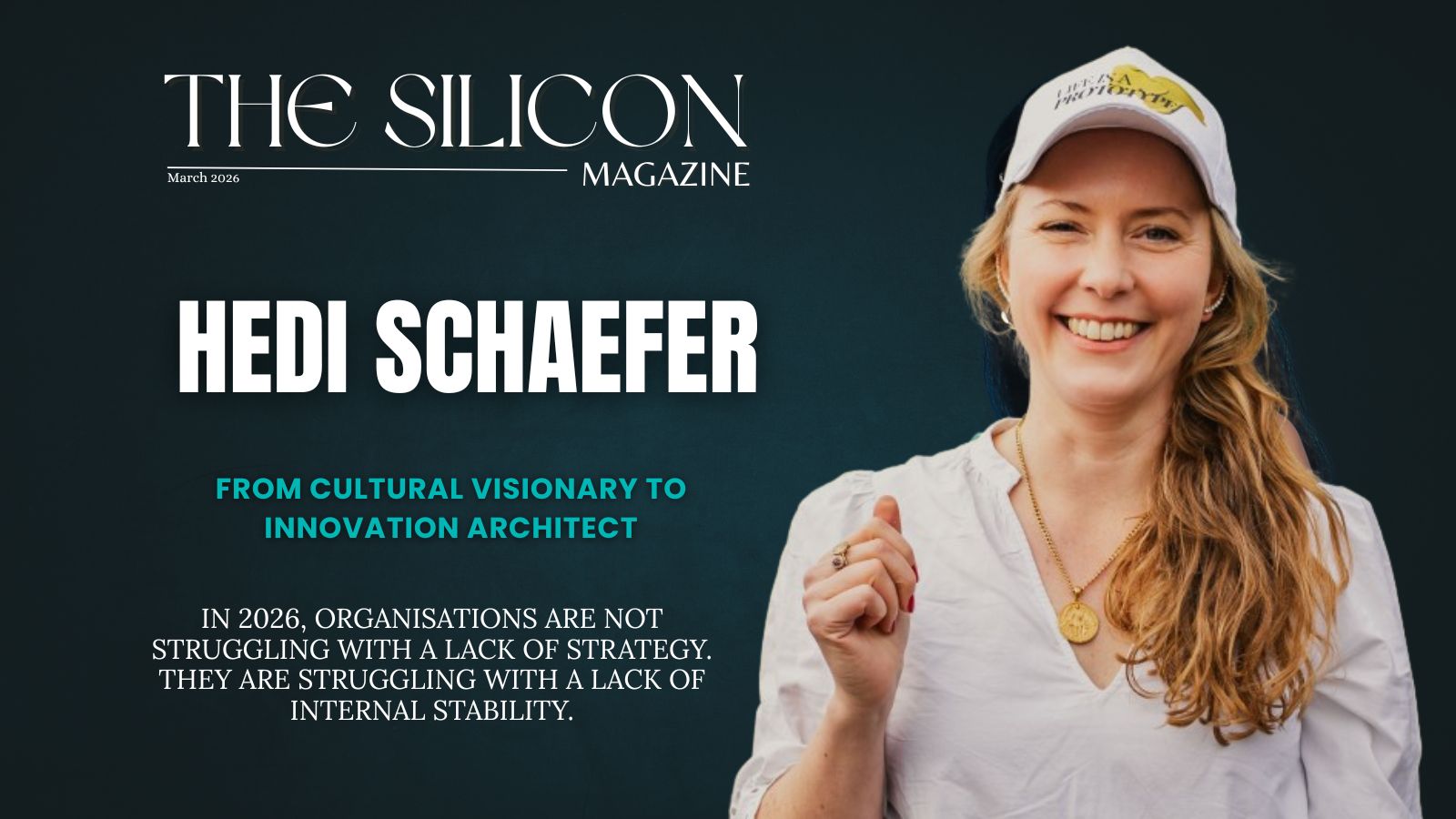
Why Inner Architecture Is the Next Frontier of Innovation
In 2026, organisations are not struggling with a lack of strategy. They are struggling with a lack of internal stability.
Artificial intelligence is accelerating. Markets are globalizing at unprecedented speed. Innovation cycles shrink from years to months. Yet amid this external velocity, one challenge often undermines transformation efforts across industries: human overwhelm.
This is the terrain where Hedi Schaefer has built her authority.
Named among global voices shaping leadership and innovation, Schaefer stands at the intersection of technology, psychology, and culture. While many keynote speakers focus on managing disruption, she addresses a deeper question: How do leaders remain internally coherent, resilient, and stable while the world around them continuously reinvents itself?
Her answer has evolved into a globally recognized framework — the 3Cs of Change™ — and a body of work that is influencing how organizations approach transformation from the inside out.
From Cultural Visionary to Innovation Architect
Long before entering corporate boardrooms, Schaefer was shaping transformation in the arts.
As founder of RITA – Resonance In The Arts, she worked alongside visionaries such as Christoph Schlingensief and Herbert Grönemeyer, contributing to projects connected to institutions like the Salzburg Festival and the Cape Town Opera.
In 2010, she organized Piano City Berlin — a city-wide cultural experiment featuring more than 70 concerts in a single weekend. Realized on an almost impossible budget, the event mobilized an entire community of artists and volunteers. It became both a creative triumph and a formative leadership lesson:
Innovation is never a solo act. It is an ecosystem.
This early immersion in large-scale creative production sharpened her ability to navigate complexity — a skill that would later define her corporate impact.
Germany’s First Generation of Design Thinking
By 2010, Schaefer entered a new frontier: innovation strategy.
As part of Germany’s first generation of Design Thinking practitioners, she contributed to embedding human-centered innovation into organizations navigating digital transformation. Over the next 15+ years, she supported Fortune 500 corporations, startups, NGOs, cultural institutions, and Schools of Design Thinking across Malaysia, China, and South Africa.
Her portfolio spans collaborations with companies such as SAP, Deutsche Bank, and Volkswagen — advising leadership teams and coaching high-profile executives and emerging innovators.
She also founded Hedi’s Innovationgym, a space dedicated to strengthening innovation mindset and leadership capacity beyond traditional workshop formats.
Across continents and sectors, one pattern became evident:
Organizations were learning to innovate externally.
But leaders were not being equipped to evolve internally at the same pace.
The Hidden Cost of High Performance
Externally, the trajectory was impressive.
She was teaching innovation, facilitating large-scale workshops, shaping organizational cultures, and contributing to global conversations on human-centered design. While constantly evolving with university degrees and leadership certificates.
Internally, something was unsustainable.
Like many leaders operating in high-growth environments, Schaefer experienced the invisible strain of continuous performance. Productivity became identity. Achievement became validation.
The turning point was not professional failure. It was motherhood.
The experience of becoming a mother forced the search for deeper meaning and impact. And pivoting. The same woman who had designed innovation systems for multinational corporations realized she had not designed her own life architecture with the same intentionality.
The insight was radical in its simplicity:
If products, services, and companies can be prototyped — why not identity?
The 3Cs of Change™: A Framework for Identity Innovation
From that personal inflection point emerged the 3Cs of Change™ — Clarity, Cleansing, Creation.
Unlike traditional change management frameworks focused on external processes, this model integrates psychological, energetic, and strategic dimensions:
Clarity – Define purpose, values, and internal alignment before creating or scaling complexity.
Cleansing – Identify and release fear patterns, subconscious limitations, and inherited belief systems to go all in.
Creation – Design future-ready action rooted in identity, impact and meaning coherence rather than pressure and performance.
The premise challenges conventional leadership thinking:
Transformation fails not because strategies are weak — but because identities are misaligned.
This framework now underpins her keynotes, corporate programs, published work, and digital platforms, including the Impact Boutique App.
Internal Mastery: The Competitive Advantage No Algorithm Can Replace
If artificial intelligence is rewriting external systems, internal mastery is rewriting human ones.
One of the most underestimated obstacles in transformation is not technological complexity — it is psychological conditioning.
Across industries and continents, Schaefer observes the same internal roadblocks surfacing in executive conversations:
“We can’t do that.”
“Who am I to lead this?”
“Others are better equipped.”
“Will I still be relevant in five years?”
Beneath these statements lies something deeper than strategy. They are echoes of the survival brain — a neurological system designed to detect threat, preserve status, and avoid uncertainty.
From a neuroscientific perspective, this makes sense. The human brain evolved to prioritize safety over expansion. It scans for danger, predicts loss, and resists unfamiliar terrain. In an era defined by AI acceleration, automation, and economic volatility, that threat-detection system is permanently activated.
The result?
High-functioning leaders operating in subtle fear.
Fear of irrelevance.
Fear of technological replacement.
Fear of failure.
Yet what Schaefer emphasizes in her work is this:
Fear is often rooted in outdated experiences — not present reality.
Many limiting beliefs were formed in earlier developmental stages: childhood environments, early career setbacks, cultural expectations, inherited narratives about success and worth. These patterns become internal operating systems — automated, invisible, and rarely questioned.
Research suggests that up to 95% of human behavior is driven by subconscious processes. If transformation initiatives address only the conscious 5%, they leave the real decision-making architecture untouched.
This is where internal mastery becomes strategic.
Through the 3Cs of Change™, leaders are guided to surface and rewire these patterns:
Identifying inherited beliefs that no longer serve the path ahead
Rebuilding inner safety independent of external proof of concept
Training the nervous system to interpret uncertainty as opportunity rather than threat
Because inner safety is trainable.
Confidence is trainable.
Resilience is trainable.
Creative risk tolerance is trainable.
When leaders build internal coherence, fear of AI shifts from existential threat to curiosity. Instead of asking, “Will I survive this?” the question becomes, “How will I shape this?”
In Schaefer’s framing, the ultimate leadership question of the next decade is simple:
Will you be the driver — or will you be driven?
Technology will continue to evolve. Markets will continue to shift. But individuals who master their internal architecture retain agency.
Her mission extends beyond equipping audiences with tools for change.
Her goal is to transform them into change-makers.
Because the future does not belong to those who react fastest.
It belongs to those who remain internally steady enough to lead it.
Industry Impact: Human Sustainability in the Age of AI
As artificial intelligence redefines operational efficiency, a new bottleneck has emerged: human nervous systems under chronic stress.
Schaefer’s contribution to the innovation landscape lies in reframing transformation as an identity evolution challenge rather than a purely technical one.
Her TEDx talk, “Life is a Prototype,” crystallized this message for broader audiences: experimentation is not just a product methodology — it is a life methodology.
In addition to her keynote work, she is:
BRAINZ 500 Global Award Winner (2023)
G100 Chair for Entrepreneurship & Sustainable Business (Germany)
Author and co-author of multiple books, including the Amazon bestseller Time Poor, Design Thinking and The Online Workshop Playbook
Contributor to BRAINZ Magazine with widely read articles on self-leadership, resilience, and innovation
Featured guest on international podcasts spanning leadership, resilience, entrepreneurship, and conscious business
Her thought leadership reaches audiences across Europe, the United States, and international English-speaking markets — bridging innovation discourse with psychological depth.
Business Model: Designing an Ecosystem, Not Just a Stage Career
Schaefer’s business architecture mirrors her philosophy.
Rather than operating solely as a keynote speaker, she has developed a multi-channel ecosystem:
Global keynotes and executive engagements
Corporate transformation program like “Selfleadership In Times Of Change”
Published books and editorial contributions
The Impact Boutique App, a transformation ecosystem
The change:liscious podcast
This diversified structure ensures that transformation is sustained beyond a single event.
Her programs particularly resonate with high performers, female leaders, and innovation-driven organizations seeking sustainable growth rather than burnout-fueled acceleration.
Leadership Philosophy: Redesign Before You Scale
One of Schaefer’s recurring questions to executives is deceptively simple:
If your organization doubled tomorrow, would your identity sustain it? If everything changes, will you still be the driver, hands on the wheel?
This resonates deeply in startup ecosystems and rapidly scaling technology hubs in both the United States and India.
Her philosophy rejects the binary between ambition and well-being. Instead, she proposes self-mastery, knowing:
Ambition without inner alignment creates fragility.
Alignment without ambition limits impact.
Self-leadership becomes the stabilizing force between the two.
Navigating Resistance in Traditional Systems
Introducing subconscious identity work into boardroom conversations is not without friction.
Schaefer bridges this gap through measurable impact narratives: decision clarity, burnout reduction, stronger team coherence, and improved innovation sustainability.
Her background in design thinking provides the credibility bridge. Her psychological expertise provides the depth.
Together, they form a rare hybrid: strategic fluency combined with inner transformation competence.
The Global Vision: 2030 and Beyond
By 2030, Schaefer envisions a future where human mastery and organizational innovation are inseparable:
A global certification ecosystem for the 3Cs of Change™, empowering leaders to lead transformation consistently
Institutional adoption of